Woodland History
Grizzly bears and elk once roamed the vast oak woodlands that gave Woodland its name. The Patwin people settled in this fertile valley approximately 2,000 years ago and lived from its abundant natural resources, including acorns, berries, roots, fish, waterfowl, and game. The nearby wetlands also provided tules used to build homes and gathering places.
The Patwin lived here undisturbed for centuries until the early 1800s, when Spanish explorers, fur trappers, and settlers began arriving in California. Disease introduced by newcomers devastated the native population, and by the mid-nineteenth century, American settlers were moving into the lower Sacramento Valley.
Woodland's beginnings can be traced to the early 1850s. "Uncle Johnny" Morris settled here in 1851, followed by Henry Wyckoff, who established a store known as "Yolo City." The town's future changed with the arrival of Frank S. Freeman in 1857. Freeman purchased Wyckoff's store, acquired surrounding land, and began developing a town he envisioned as a commercial center for one of California's richest agricultural regions.
In 1861, a U.S. Post Office was established and named Woodland at the suggestion of Freeman's wife, Gertrude, in recognition of the wooded landscape surrounding the settlement. Woodland's location on higher ground soon proved advantageous. During the great flood of 1862, much of the surrounding valley was inundated, including the county seat at Washington (present-day West Sacramento). As a result, the Yolo County seat was permanently moved to Woodland.
Freeman formally laid out the town in 1863, and Woodland quickly grew as families, businesses, schools, churches, and public institutions were established. By the mid-1860s, Woodland had become the county's principal commercial center and was serving the surrounding farming community.
The arrival of the railroad in 1869 accelerated Woodland's growth and connected the town to markets throughout California. Woodland was incorporated in 1871, and the railroad tracks were relocated to their present alignment along East Street the following year. With reliable transportation and communication links, the city continued to prosper.
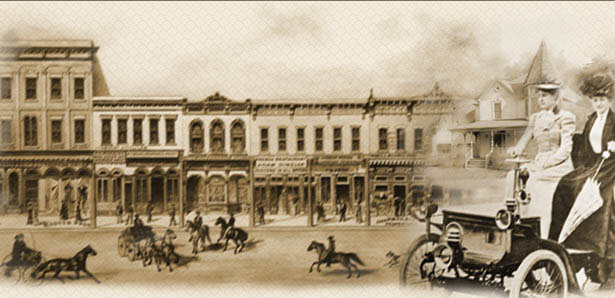
By the late nineteenth century, Woodland had become one of California's most successful agricultural communities. Many of the historic homes featured on the Stroll Through History were constructed during this period, along with schools, churches, community buildings, and the town's impressive opera house.
Disaster struck on July 1, 1892, when a fire swept through part of the downtown business district, destroying numerous buildings, including the opera house. Although rebuilding was slowed by a nationwide economic depression, Woodland recovered and rebuilt its commercial center by the mid-1890s.
The twentieth century brought continued growth and civic improvement. Community leaders helped establish many of the institutions that continue to serve Woodland today, including the public library, City Park, and cemetery. Agricultural industries, including rice milling, sugar beet processing, and tomato canning, contributed to the local economy for decades.
Following World War II, Woodland experienced significant growth as California's population expanded. New neighborhoods, businesses, and industries developed around the city. Beginning in the late 1960s, residents also began working to preserve Woodland's historic buildings and neighborhoods. Many of these structures were restored and adapted for use as homes, offices, businesses, and museums.
In 1989, the Woodland community launched the first Stroll Through History to celebrate the city's remarkable architectural heritage. What began as a single-day event has become a beloved annual tradition, inviting visitors to explore Woodland's historic neighborhoods, homes, and stories each October.
Today, Woodland continues to balance growth with preservation, honoring the people, places, and architecture that have shaped its unique character for more than 150 years.
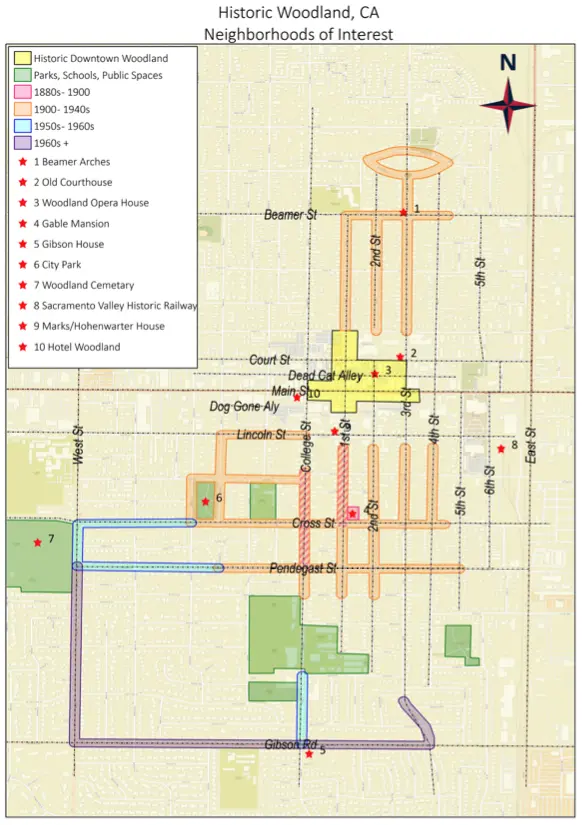
Here is a general map to orient newcomers to our town to the primary historic areas of Woodland.